




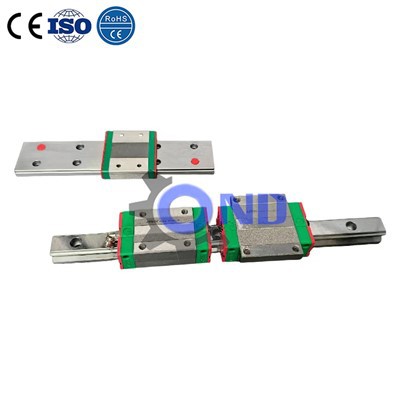
Linear Guide Rail
Tianjin OuNaiDa Transmissions Technology Co., Ltd. is one of the leading manufacturers and suppliers of linear guide rail in China. If you're going to buy high quality linear guide rail, welcome to get more information from our factory. Also, custom service is available.
Product Description
| Product Name | linear guide rail |
| Material | Bearing steel |
| Size | 15,20,25,30,35,45,55,65,etc |
| Length | 100mm,300mm,500mm,1000mm,2000mm,3000mm,4000mm,etc. |
| Certification | ISO9001, CE |
| Used | Semiconductor manufacturing equipment, industrial production equipment, robots,CNC woodworking machinery, CNC laser engraving machine, CNC laser cutting machine,etc; |
Linear guide rail is used in high-precision or high-speed linear reciprocating motion applications and can withstand a certain amount of torque, enabling high-precision linear motion under high load conditions.
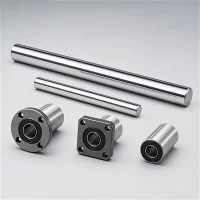
Linear guide rail is used to support and guide moving parts, enabling them to reciprocate linearly in a given direction. Based on the nature of friction, linear guide rail can be classified into sliding friction guides, rolling friction guides, elastic friction guides, and fluid friction guides. Linear bearings are mainly used in automated machinery, such as German-imported machine tools, bending machines, and laser welding machines. Of course, linear bearings and linear shafts are used in conjunction. Linear guides are primarily used in mechanical structures with high precision requirements. The moving and stationary elements of a linear guide do not require an intermediate medium; instead, rolling steel balls are used.
Working principle
This can be understood as a type of rolling guide, where steel balls endlessly roll and circulate between the slider and the guide rail, allowing the load platform to move easily and linearly along the guide rail with high precision. It also reduces the coefficient of friction to one-fiftieth of that of traditional sliding guides, easily achieving very high positioning accuracy. The end-control unit design between the slider and the guide rail allows the linear guide rail to simultaneously bear loads in all directions, including up, down, left, and right. The patented recirculation system and simplified structural design result in smoother and quieter movement for the linear guide rail.
The slider transforms motion from a curve to a straight line. The new guideway system enables machine tools to achieve rapid feed rates; rapid feed is a characteristic of linear guideways at the same spindle speed. Like planar guideways, linear guideways have two basic components: a fixed element that acts as a guide, and a moving element. Since linear guideways are standard components, the only task for machine tool manufacturers is to machine a mounting plane and adjust the parallelism of the guideways. Of course, to ensure machine tool accuracy, a small amount of scraping of the bed or column is essential; in most cases, installation is relatively simple. The guideway, acting as a guide, is made of hardened steel and, after precision grinding, is placed on the mounting plane. Compared to planar guideways, the cross-sectional geometry of linear guideways is more complex. This complexity arises because grooves need to be machined into the guideway to facilitate the movement of the sliding element. The shape and number of grooves depend on the function the machine tool needs to perform. For example, a guideway system that withstands both linear forces and overturning moments differs significantly in design from a guideway that only withstands linear forces.
The basic function of the fixed element (guide rail) in a linear guide system is similar to that of a bearing ring, a bracket for mounting steel balls, and it is shaped like a "V". The bracket surrounds the top and two sides of the guide rail. To support the working parts of a machine tool, a linear guide system has at least four brackets. For supporting large working parts, the number of brackets can be more than four.
When the working parts of the machine tool move, the steel balls circulate in the grooves of the support, distributing the wear of the support to each steel ball, thereby extending the service life of the linear guide. To eliminate the gap between the support and the guide, preload improves the stability of the guide system. Preload is obtained by installing oversized steel balls between the guide and the support. The diameter tolerance of the steel balls is ±20 micrometers, and they are sorted and installed on the guide in 0.5-micrometer increments. The magnitude of the preload depends on the force acting on the steel balls. If the force acting on the steel balls is too large, or the preload time is too long, the resistance to movement of the support will increase, leading to a balance problem. To improve the system's sensitivity and reduce movement resistance, the preload should be reduced accordingly. However, to improve movement accuracy and accuracy retention, a sufficient preload is required-these are contradictory aspects.
Over time, the steel balls begin to wear, reducing the preload acting on them and consequently decreasing the motion accuracy of the machine tool's working parts. To maintain initial accuracy, the guide rail support, or even the guide rail itself, must be replaced. If the guide rail system already has a preload, and system accuracy has been lost, the only solution is to replace the rolling elements.
The design of guide rail systems aims to maximize the contact area between fixed and moving elements. This not only improves the system's load-bearing capacity but also enables it to withstand the impact forces generated by intermittent or heavy cutting, widely distributing the force and expanding the load-bearing area. To achieve this, guide rail systems employ various groove shapes, with two representative types: Gothic (pointed arch) grooves, which are extensions of a semicircle with the contact point at the apex; and arc-shaped grooves, which serve the same purpose. Regardless of the structural form, the goal is the same: to maximize the contact radius of the rolling steel balls with the guide rail (fixed element). The key factor determining the system's performance characteristics is how the rolling elements contact the guide rail.
Hot Tags: linear guide rail, China linear guide rail manufacturers, suppliers, factory, positioning system linear guideways, linear guideway slides, linear guideway shafts, linear guideway energy efficient, linear guideway flexible design, linear guideway custom design
Previous
Linear Guide Rail SystemNext
Linear guidewayYou Might Also Like



Send Inquiry