


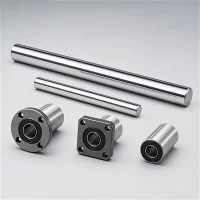

Gear Rack
What Is Gear Rack
Gear racks are utilized to convert rotating movement into linear motion. A gear rack has straight teeth cut into one surface of a square or round section of rod and operates with a pinion, which is a small cylindrical gear meshing with the gear rack.
Advantages of Gear Rack
Precise Linear Motion
Rack and pinion gears provide accurate and controlled linear motion. The meshing of the gear teeth ensures a smooth and consistent movement, allowing robots and automated systems to achieve precise positioning and repeatability in their operations.
High Efficiency
Rack and pinion gears have high mechanical efficiency, translating most of the input power into linear motion. Their tooth engagement ensures minimal power losses, making them energy-efficient and suitable for applications where power conservation is essential.
Compact Design
The linear motion in rack and pinion systems occurs along a single axis, resulting in a compact and space-saving design. This is particularly advantageous in robotics and automation, where space constraints are common, and compact components are desirable for efficient integration.
Low Backlash
Rack and pinion gears can be designed to have minimal backlash, which is the play or clearance between gear teeth. Low backlash ensures accurate motion control and reduces the possibility of positioning errors or vibration during robot operations.
High Load-Carrying Capacity
Rack and pinion gears can handle significant loads, making them suitable for various robotics and automation tasks that involve moving heavy objects or applying force in industrial settings.
Easy to Implement and Control
Rack and pinion systems are relatively simple in design and easy to implement in robotics and automation setups. They can be coupled with various actuators, such as motors and servos, and controlled using standard motion control techniques.
Quiet Operation
Well-designed rack and pinion gear systems exhibit smooth and quiet operation due to their gradual tooth engagement. In noise-sensitive environments or applications where reduced noise is preferred, rack and pinion gears are advantageous.
Durability and Longevity
Properly designed rack and pinion gear systems, with suitable materials and heat treatment, exhibit excellent durability and wear resistance. This ensures a longer service life, reduced maintenance requirements, and improved reliability for robotic and automated systems.
Flexibility and Customization
Rack and pinion gears can be customized to suit specific robotic and automation applications. Designers can adjust gear parameters, such as tooth profile, module, pitch, and length, to match the requirements of the system, allowing for flexibility in design.
Wide Range of Applications
Rack and pinion gears are versatile and find applications in various robotics and automation tasks, such as pick-and-place operations, assembly lines, material handling, CNC machines, 3D printers, and more.


Why Choose Us
Custom Solutions: We understand that each application has unique requirements, and our team can work with you to develop custom sprockets tailored to your specific needs. Whether you're looking for a reliable custom sprockets Manufacturer to meet your unique demands, we have the expertise and experience to deliver the high quality solutions you require.
Quality Assurance: We take pride in providing Sprockets of the highest quality, precision, and performance. Our products undergo stringent testing to ensure they meet or exceed industry standards.
Technical Support: Our experienced team is ready to assist you with product selection, installation guidance, and any technical inquiries you may have.
Application Areas: Sprockets are widely used in various industries, including conveyor systems, packaging machinery, agricultural equipment, and more.
How to Use the Gear Rack

Gear racks convert power and motion from rotary motion into linear motion. For straight tooth gear racks, the mating pinion must be the same pitch, and the same pressure angle. When the gear rack teeth are helical, the pitch, the pressure angle, and the helix angle of both the pinion and the gear rack must be the same; however, the direction of the helix angle of each component must be opposite.
The teeth of a gear rack are cut using a rack milling machine. The milling head machines a section of rack and then indexes to the adjacent section until the rack is completed. The maximum length of a rack is only limited by the length of the milling machine. Gear racks can be produced from various materials, including steel, brass, bronze, or plastic, and depending on the application, they can be hardened based on the requirements for strength and durability.
The geometry of a gear rack is defined by several parameters. In a theoretical sense, a gear rack is just a spur gear with an infinite pitch diameter. The calculations vary depending on whether the teeth are produced in the normal system or the transverse system.
The first value needed to produce a gear rack is the pitch. In the metric system, this is known as the module. As the value of the module increases, the size of the gear tooth increases. In the English standard system, the pitch of a helical gear is known as the diametral pitch (DP). It represents the number of teeth that are found on a gear with a one-inch reference diameter.
The pressure angle is the angle between the line of action of the gears and the tangent to the pitch circle. It determines the contact between the teeth of the gears and affects the load-carrying capacity and efficiency of the gears. In the English system, helical gears typically have values for pressure angle of 20 degrees or 14 degrees 30 minutes. For metric helical gears, the pressure angle is typically 20 degrees.


The number of teeth for the pinion is chosen by the end-user based on the speed ratio that is desired for the application. Each rotation of the pinion will travel a specific linear distance along the gear rack. A pinion with a smaller number of teeth will need to rotate faster than a larger pinion in order to travel the same distance.
The addendum of a gear rack tooth is the linear distance between the pitch height and the tooth tip. Correspondingly, the dedendum is the linear distance between the pitch height and the tooth root. The sum of the addendum and the dedendum determines the total tooth height.
The value for backlash is important for gear racks. This value measures the distance between the pinion gear teeth and the rack gear teeth when they are not in contact. It is necessary to have a minimum amount of backlash for the gear teeth to mesh properly and for lubricant to engage with the rack and pinion at their point of contact. As rack and pinion systems are typically used for positioning applications, the accumulation of backlash errors can have a significant impact on position accuracy. Additional mechanisms such as optical encoders are incorporated into rack and pinion systems in order to maintain positional accuracy.
The design of gear rack involves determining the pitch height, module, pressure angle, addendum, dedendum, and backlash. These factors are dependent on the desired speed ratio, power transmission requirements, and the design of the mechanical system. Gear racks will only transmit power between perpendicular axes. As the pinion rotates, the teeth engage and transmit torque from the pinion to the gear rack. If the rack is fixed and the pinion is rotated clockwise, then the pinion will translate to the right. If the pinion is fixed and rotates clockwise, then the rack will translate to the left. The distance of translation along the rack is equal to the pitch circumference of the pinion. When using a normal module, this distance is fractional. When using a circular pitch instead of module, you can achieve a fixed translation. For example, a module 3 pinion with 30 teeth will translate 282.74 millimeters per rotation, whereas a CP10 pinion with 30 teeth will translate exactly 300 millimeters per rotation. Another way to achieve a fixed rotational value is to use a helical rack and pinion with a helix angle of 19° 31’ 41” as this value converts module to circular pitch as well.
Gear racks are a commonly used element in mechanical systems because they are simple in design, efficient in operation, and cost-effective. Understanding the technical definitions and design principles of gear racks is essential for anyone working with mechanical systems.

Applications of Gear Rack
Gear racks are utilized to convert rotating movement into linear motion. A gear rack has straight teeth cut into one surface of a square or round section of rod and operates with a pinion, which is a small cylindrical gear meshing with the gear rack. Generally, gear rack and pinion are collectively called “rack and pinion”. There are many ways to use gears. For example, as shown in the picture, a gear is used with the gear rack to rotate a parallel shaft.
To provide many variations of rack and pinion, it has many types of gear racks in stock. If the application requires a long length requiring multiple gear racks in series, we have racks with the tooth forms correctly configured at the ends. These are described as “gear racks with machined ends”. When a gear rack is produced, the tooth cutting process and the heat treatment process can cause it to try & go out of true. We can control this with special presses & remedial processes.
There are applications where the gear rack is stationary, while the pinion traverses and others where the pinion rotates on a fixed axis while the gear rack moves. The former is used widely in conveying systems while the latter can be used in extrusion systems and lifting/lowering applications.
As a mechanical element to transfer rotary into linear motion, gear racks are often compared to ball screws. There are pros and cons for using racks in place of ball screws. The advantages of a gear rack are its mechanical simplicity, large load carrying capacity, and no limit to the length, etc. One disadvantage though is the backlash. The advantages of a ball screw are the high precision and lower backlash while its shortcomings include the limit in length due to deflection.
Rack and pinions are used for lifting mechanisms (vertical movement), horizontal movement, positioning mechanisms, stoppers and to permit the synchronous rotation of several shafts in general industrial machinery. On the other hand, they are also used in steering systems to change the direction of cars. The characteristics of rack and pinion systems in steering are as follows: simple structure, high rigidity, small and lightweight, and excellent responsiveness. With this mechanism, the pinion, mounted to the steering shaft, is meshed with a steering rack to transmit rotary motion laterlly (converting it to linear motion) so that you can control the wheel. In addition, rack and pinions are used for various other purposes, such as toys and lateral slide gates. Gear Rack and Pinion – creation of linear motion
A rack and pinion are used when converting rotational movement to linear motion (or vice versa). A bar shaped gear with an infinite (flat surface) radius of a cylindrical gear is called a rack, and a meshed spur gear is called a pinion. A rack can be used by extending it combining as many racks with machining operation on the end faces when necessary.
A helical rack is a bar shaped gear with slanted linear tooth trace that is used when silence and high speed rotation are required, and it can be meshed with a helical gear.
Rack and Pinion Used in Automotive Steering Mechanisms


The steering mechanism is used to change the direction of automobiles and are mainly classified into rack-and-pinion and ball nut types.
Of these two, the rack and pinion type steering mechanism has become the mainstream used in many small cars. Its construction is simple with other characteristics such as lightweight, high strength, low friction, superior responsiveness, etc.
The rack and pinion type steering mechanism consists of a pinion attached to the tip of the steering shaft on which the steering wheel is mounted. The pinion is meshed with a rack so that the movement of the handle rotates the pinion which in turn moves the rack sideways. The wheel is moved left and right through the system of tie rods connected to the ends of the rack.
(Caution : Currently, does not supply rack and pinion for automotive steering mechanisms.)
Materials and heat treating racks and pinions
As for the materials of a racks and pinions, strength, abrasion resistance, and absorbency are considered.
With steel, S45C (1045 in AISI/SAE, C45 in ISO, equivalent to C 45K in DIN), SCM440 (4140 in AISI/SAE, equivalent to 42CrMo4V in ISO and DIN), 16MnCr5 (name in ISO, equivalent to 17Cr3 in DIN), with stainless steel, SUS303 (303/S30300 in AISI/SAE, 13 in ISO, equivalent to X10CrNiS18-9 in DIN), SUS304 (304/S30400 in AISI/SAE, 6 in ISO, equivalent to X5CrNi18-10 in DIN), with plastic material, reinforced nylon called engineering plastic, polyacetal (equivalent to Duracon and POM), polyamide, are used.
Regarding the heat treatment of a rack and pinion, thermal refining, carburizing and quenching, tooth face high frequency hardening, and tooth face laser hardening are used depending on the kinds of materials and purposes.
Overall length and cross-sectional shape of a rack
The overall length of standard racks on the market is generally not more than 2000mm, and offered in 500mm units such as 500mm, 1000mm, 1500mm.
Furthermore, the cross-sectional shape is often a square or rectangle, and some are round called round rack type
Construction of Gear Racks

- Although the degree of manufacturing difficulties varies with the accuracy classes and standards, a rack cutting machine and a gear hobbing machine may still be used to make a rack and pinion.
- Standard racks available on the market are often no longer than 2000mm overall and come in 500mm chunks like 500mm, 1000mm, and 1500mm.
- Additionally, the cross-sectional form is often square or rectangular, while some are round and are referred to as round rack types.
- They are created globally by various rack and gear manufacturers.
Gear Rack’s Working Procedure
The pinion, a circular gear that drives the gear rack and moves it most about the pinion, works side by side with gear racks.
Gear racks are utilized in applications like rack railroads because they offer the additional energy necessary to propel a train up a steep incline. This mechanism transfers rotational motion.
A gear rack is frequently used in steering-wheel systems because the rotation of the steering wheel's pinion exerts a force on the gear rack, which affects the direction that a car's tires face and, ultimately, the direction of the vehicle.
Without the proper gear rack, the pinion can come loose from the gear rack's teeth, leaving the system inoperable and increasing the risk of damage and associated safety issues.
Our Factory
Our factory is established in 2008 and at 2010 we founded foreign trading company-Tianjin Ounaida Transmissions Technology Co., Ltd.Our factory has advanced and precise equipment to efficiently complete the production of products.


FAQ
Q: What is a gear rack?
Q: How do you rack and pinion gear?
Q: What is the gear rack attached to?
Q: What is an example of a gear rack?
Q: What are gear racks made of?
Q: What parts come with a rack and pinion?
Q: How do you cut a gear rack?
Q: How do you measure a gear rack?
Q: What machine cuts gears?
Q: How do you match gear with gear rack?
Q: How does a gear rack work?
Q: What is the standard rack gear size?
Q: What is the gear rack attached to?
Q: What is the center distance of a gear rack?
Q: What is the gear ratio of a gear rack?
Q: What is a steering gear rack?
Q: How do you calculate center distance of rack and pinion?
Q: What is the torque of a rack and pinion?