


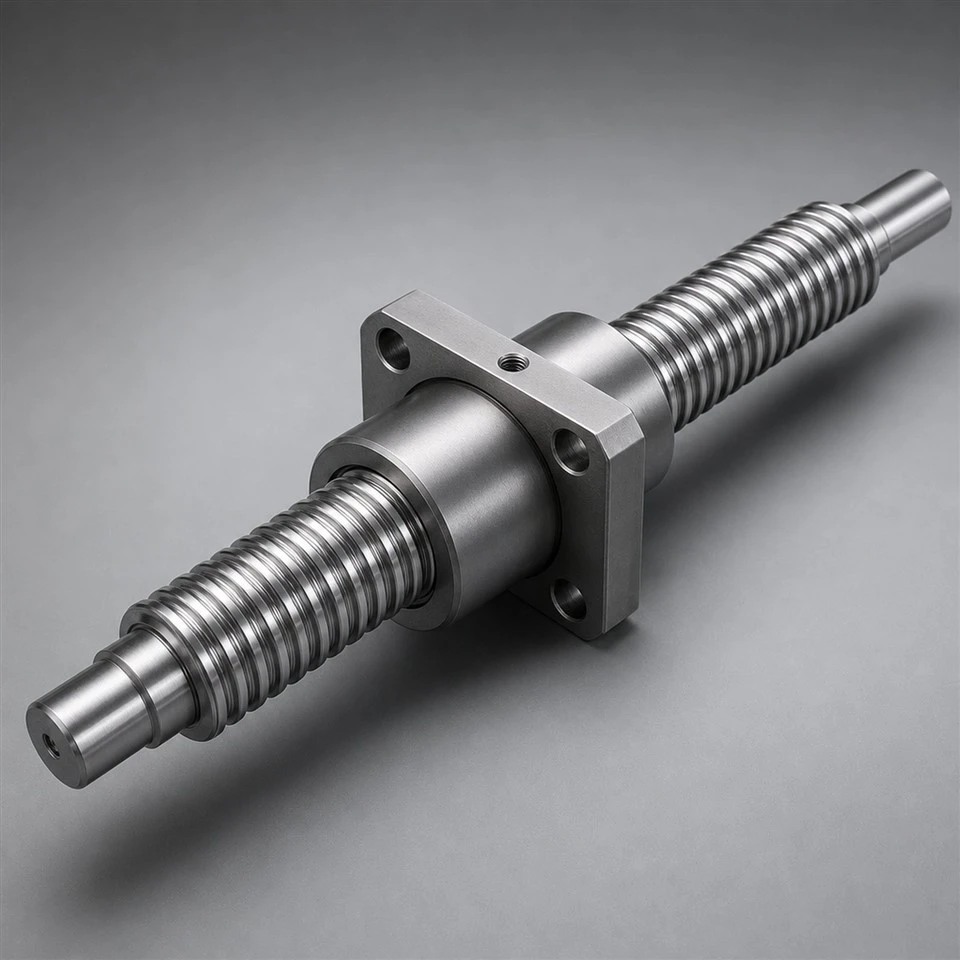
Internal-Circulation Ball Screw
Tianjin OuNaiDa Transmissions Technology Co., Ltd. is one of the leading manufacturers and suppliers of internal-circulation ball screw in China. If you're going to buy high quality internal-circulation ball screw, welcome to get more information from our factory. Also, custom service is available.
SFI2005-4 Internal-Circulation Ball Screw: 34 mm Nut OD, 1,551 kgf Dynamic Load
A machine builder in Turkey had a 20 mm ball screw spec'd into a gantry Z axis and ran out of room. The nut cleared the casting on three sides, but the return tube on the fourth side fouled a cable chain bracket by about 4 mm. His options were to re-machine the casting, move the cable chain, or find a nut without a tube sticking out of it.
He took the third option. The SFI2005-4 carries the same 20 mm shaft and 5 mm lead as the SFU2005, same load ratings, but the balls return inside the nut body instead of through an external pipe. Nut OD drops from 36 mm to 34 mm, and more importantly the outside of the nut is a plain cylinder.
Dimensions and load ratings
Catalogue figures for the SFI2005-4, with its two nearest SFI neighbours for context.
| Model | Shaft d (mm) | Lead l (mm) | Ball dia. Da (mm) | Nut D (mm) | A (mm) | B (mm) | L (mm) | W (mm) | H (mm) | X (mm) | Y (mm) | Z (mm) | Q | Circuits n | Ca (kgf) | Coa (kgf) | Rigidity (kgf/µm) | Weight (kg) |
|---|---|---|---|---|---|---|---|---|---|---|---|---|---|---|---|---|---|---|
| SFI2004-4 | 20 | 4 | 2.381 | 34 | 57 | 11 | 46 | 45 | 40 | 5.5 | 9.5 | 5.5 | M6 | 1×4 | 1,066 | 2,987 | 37 | 0.312 |
| SFI2005-4 | 20 | 5 | 3.175 | 34 | 57 | 11 | 51 | 45 | 40 | 5.5 | 9.5 | 5.5 | M6 | 1×4 | 1,551 | 3,875 | 39 | 0.308 |
| SFI1605-4 | 16 | 5 | 3.175 | 30 | 49 | 10 | 50 | 39 | 34 | 4.5 | 8 | 4.5 | M6 | 1×4 | 1,380 | 3,052 | 33 | 0.220 |
One oddity in that table: the 2005 is listed at 0.308 kg against the 2004's 0.312 kg, despite the longer 51 mm nut body. Catalogue weights are what they are - if mass matters to your inertia calculation, work from the figure rather than from the dimensions.
What the SFI buys you over the SFU
Both are single flange nuts. Both are rolled screws. Here is the 20 mm comparison from the same catalogue, side by side:
| SFI2005-4 (internal) | SFU2005-3/4 (external) | |
|---|---|---|
| Nut OD D | 34 mm | 36 mm |
| Flange A | 57 mm | 58 mm |
| Nut length L | 51 mm | 44 mm (3 circuits) / 51 mm (4 circuits) |
| Bolt circle W × H | 45 × 40 mm | 47 × 44 mm |
| Bolt hole X | 5.5 mm | 6.6 mm |
| Circuits n | 1×4 | 1×3 or 1×4 |
| Ca | 1,551 kgf | 1,551 kgf |
| Coa | 3,875 kgf | 3,875 kgf |
| Rigidity | 39 kgf/µm | 38 kgf/µm |
| Weight | 0.308 kg | 0.316 kg |
Load ratings are identical. You are not trading capacity for size. What you are buying is 2 mm off the diameter, 4 mm off the bolt circle in two directions, and the absence of a return pipe on the outside of the nut.
The size argument is not marginal in every case. THK, describing its deflector-type internal circulation nut, puts the outer diameter at 70% to 80% of a return-pipe nut and the overall length at 60% to 80%, which reduces weight and cuts inertia during acceleration. Our SFI gap is narrower than that because the comparison is between two rolled single-nut designs rather than a deflector nut against a pipe nut, but the direction is the same.
The shaft-end rule that stops assembly
This is the part that catches people, and it catches them after the screw is already machined.
An internal-circulation nut cannot be threaded onto the shaft from just anywhere. PMI states the condition plainly for its internal ball series: at least one end of the screw shaft must carry complete threads, and the area next to that complete thread must be smaller in diameter than the nominal diameter of the shaft. Both conditions exist so the nut can be slid on.
In practice that means:
- If both your shaft ends are machined up to a shoulder larger than the thread root, the nut has nowhere to enter. The screw is scrap, or you re-machine one end.
- If your thread runs out gradually at both ends with no section of full-profile thread, the balls will not pick up the groove correctly on entry.
- You cannot fit an internal-circulation nut to an existing shaft that was cut for an external nut without checking this first.
An external nut is more forgiving here, which is one reason the SFU is still the default on quick-turn orders. If you are sending a drawing for SFI machining, mark which end the nut enters from.
Mounting orientation, and a torque effect you can design out
THK makes a point about return-pipe and return-piece screws that is worth repeating because it affects the SFI argument indirectly: with those nuts mounted horizontally, the torque on the outbound and inbound cycle differs depending on how the circulation part is oriented, and the recommendation is to design with the circulation part facing downwards for consistent torque.
With internal circulation that orientation question disappears from the nut. The flange bolt pattern still has to be right, but you do not have a tube on one flank making the axis behave differently on the forward and return stroke.
What stays the same: the mounting accuracy rules. THK is blunt that an offset or skew between the shaft support and the nut can substantially shorten service life, and that insufficient rigidity or accuracy in the mounting members concentrates the bearing load on one point, dropping bearing performance significantly. A compact nut does not relax any of that. If anything, a tighter installation gives you less room to shim your way out of a misalignment.
Lubrication
Standard M6 lubrication port, dimension Q. THK's published guideline for ball screws is to lubricate roughly every 100 km of travel distance, or three to six months, with the final interval and amount set against the actual machine. Two conditions change that number:
If cutting chips or other foreign material get on the screw, clean it first, then replenish the lubricant - adding grease over contamination just carries the abrasive into the nut.
If your axis does short oscillating strokes rather than full travel, THK notes that micro-oscillation makes it hard for an oil film to form, which can lead to fretting. Their advice is to use a grease with good fretting toughness and to rotate the nut a full turn periodically so a film forms across the whole raceway. Short-stroke pick-and-place axes are the usual offenders.
When to choose SFU instead
Pick the SFU2005 if your housing has clearance anyway, you want the shorter 44 mm nut option, or you need the shaft end machining to stay flexible. The external nut is cheaper to source in volume and does not carry the shaft-entry constraint.
Pick the SFI2005-4 when space on one flank is the binding constraint, or when a protruding tube would collide with guarding, a cable carrier, or a neighbouring axis.
For the broader selection question, how to choose the right ball screw covers the load and speed side, and lead versus speed and thrust explains why a 5 mm lead is the right starting point for a loaded vertical axis. If positioning tolerance drives the spec rather than packaging, read rolled versus ground ball screws first - the SFI2005-4 is a rolled screw.
Pairing
End support: a BK12/FK15 support unit suits the 20 mm shaft once the ends are machined; see end support configuration for the fixed/supported decision. If you need the nut carried rather than bolted directly to a plate, we stock a ball screw nut housing. Guide element is not optional - THK's handling instructions require the screw to be used with an LM guide, ball spline or equivalent, or the screw itself can be damaged.
What we need to quote
Shaft overall length, thread length, which end the nut enters from, end machining drawing or support unit model, span between bearing supports, and whether the axis is horizontal or vertical. The shaft-end detail matters more on an SFI than on an SFU, so send the drawing rather than just the model code.
Dimensional and load data in this article come from the OND SFI and SFU series tables. Internal-circulation nut proportions and lubrication intervals are cited from THK published technical pages; the shaft-end assembly requirement is cited from PMI. Verify the final specification against the drawing supplied with your order.
Hot Tags: internal-circulation ball screw, China internal-circulation ball screw manufacturers, suppliers, factory
Previous
No InformationYou Might Also Like


Send Inquiry