Linear Guideway Preload and Ball Screw Accuracy: Specifying Without Overpaying

Precision machining and inspection capability
Target keyword: linear guideway preload classes
Secondary: ball screw accuracy grade C3 C5 C7, linear guide preload Z0 ZA ZB, linear guide accuracy class
Meta description: Real preload values, accuracy class tables and load ratings from published catalogues. Why accuracy grade does not determine backlash, and how to pick the class your machine needs.
Two specifications get copied onto drawings more often than any others in linear motion: "C3 ball screw" and "preloaded linear guides." Both sound rigorous. Neither is complete, and both cost money that is often wasted.
Here is what the published catalogue data actually says.
Linear guideway accuracy classes
Profiled rail guideways are graded in five accuracy classes: normal (C), high (H), precision (P), super precision (SP) and ultra precision (UP).
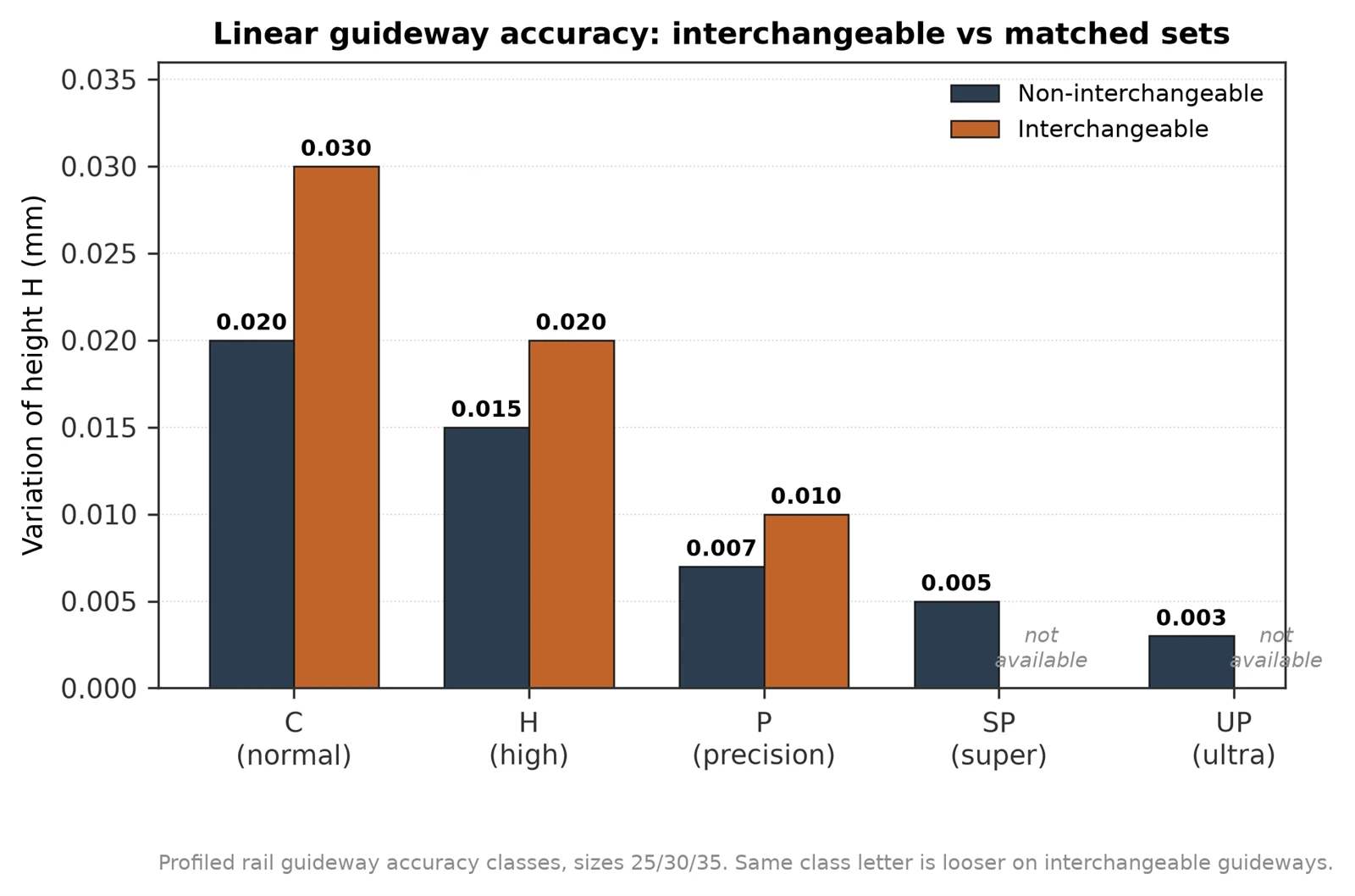
Figure 1. Accuracy classes: interchangeable guideways are looser at the same class letter.
For non-interchangeable guideways in sizes 25, 30 and 35 (unit: mm):
|
Item |
C |
H |
P |
SP |
UP |
|
Height H tolerance |
±0.1 |
±0.04 |
0 / −0.04 |
0 / −0.02 |
0 / −0.01 |
|
Width N tolerance |
±0.1 |
±0.04 |
0 / −0.04 |
0 / −0.02 |
0 / −0.01 |
|
Variation of height H |
0.02 |
0.015 |
0.007 |
0.005 |
0.003 |
|
Variation of width N |
0.03 |
0.015 |
0.007 |
0.005 |
0.003 |
For sizes 15 and 20:
|
Item |
C |
H |
P |
SP |
UP |
|
Height H tolerance |
±0.1 |
±0.03 |
0 / −0.03 |
0 / −0.015 |
0 / −0.008 |
|
Variation of height H |
0.02 |
0.01 |
0.006 |
0.004 |
0.003 |
Representative catalogue values for a standard profiled rail series.
Two things in the structure are worth pausing on.
Tolerance flips from bilateral to unilateral at P class. Classes C and H are ±; P, SP and UP are 0 / −x. That is deliberate - for matched sets, controlling the direction of deviation lets blocks be paired predictably. You cannot compare "±0.04" against "0/−0.04" as if they were the same tolerance band.
Variation matters more than absolute tolerance for most machines. "Variation of height H" is the spread between blocks on the same rail. If all your blocks are 0.03 mm low by the same amount, you shim the assembly once. If they differ from each other by 0.03 mm, the carriage rocks and there is nothing to shim.
Interchangeable versus non-interchangeable
The distinction is straightforward: interchangeable blocks and rails can be freely exchanged, and their accuracy reaches up to P class.

Figure 2. Preload classes as a percentage of dynamic load rating C.
For interchangeable guideways:
|
Item |
C |
H |
P |
SP |
UP |
|
Height H tolerance |
±0.1 |
±0.07 |
0 / −0.07 |
- |
- |
|
Variation of height H |
0.03 |
0.02 |
0.01 |
0.007 |
0.005 |
Representative catalogue values, interchangeable type.
Compare the same class letter across the two types. At H class: variation of height is 0.015 mm non-interchangeable, 0.02 mm interchangeable. At C class: 0.02 versus 0.03 mm.
The same class letter means a looser tolerance on interchangeable guideways. And SP and UP are not available at all - those require matched sets.
The trade-off is maintenance. With interchangeable guideways you can order a replacement block in five years and fit it. With a matched set, losing one block can mean replacing the whole assembly. For a machine that will be in service fifteen years, that is worth considering at the design stage.
Preload classes - the part that gets guessed
Preload is expressed as a percentage of basic dynamic load rating C:
|
Class |
Code |
Preload |
Condition |
Applications |
|
Light |
Z0 |
0 ~ 0.02C |
Certain load direction, low impact, low precision required |
Transportation devices, auto-packing machines, X-Y axis for general industrial machines, welding machines |
|
Medium |
ZA |
0.05C ~ 0.07C |
High precision required |
Machining centres, Z axis for general industrial machines, EDM, NC lathes, precision X-Y tables, measuring equipment |
|
Heavy |
ZB |
0.10C ~ 0.12C |
High rigidity required, with vibration and impact |
Machining centres, grinding machines, NC lathes, horizontal and vertical milling machines, Z axis of machine tools, heavy cutting machines |
Representative preload class definitions.
A warning about the codes. Other guideway series use the same Z0/ZA/ZB designations with different values:
|
Class |
Code |
Preload |
|
Very light |
Z0 |
0 ~ 0.02C |
|
Light |
ZA |
0.03C ~ 0.05C |
|
Medium |
ZB |
0.06C ~ 0.08C |
Note that ZB means 0.10–0.12C in one series and 0.06–0.08C in the other - nearly a factor of two. Always specify the series along with the preload code, and check the catalogue for the specific product rather than assuming the code carries a universal meaning.
Availability: interchangeable guideways offer Z0 and ZA only. Non-interchangeable offer Z0, ZA and ZB.
Higher preload increases rigidity and reduces deflection under load. It also increases friction, heat generation and internal stress, which reduces life. Preload is not free rigidity - it consumes some of the bearing's load capacity permanently. Specify ZB when you genuinely have vibration and impact; specify Z0 when the load direction is constant and precision is not critical.
Load ratings
Heavy-load blocks, representative profiled rail series:
|
Rail size |
Dynamic C (kN) |
Static Co (kN) |
|
15 (standard block) |
11.38 |
16.97 |
|
20 |
21.18 |
35.90 |
|
25 |
32.75 |
49.44 |
|
30 |
47.27 |
69.16 |
|
35 |
60.21 |
91.63 |
|
45 |
94.54 |
136.46 |
|
55 |
139.35 |
196.20 |
|
65 |
208.36 |
303.13 |
Representative catalogue rating values.
Useful detail: at size 25, the flange-type block carries C = 32.75 kN and Co = 49.44 kN - identical to the square type. Flange versus square changes mounting geometry, not capacity. Choose on how you can get bolts into the carriage, not on load.
The four-row circular-arc design "features equal load ratings in the radial, reverse radial and lateral" directions, and the contact points at 45° give self-aligning capability: the series "can absorb most installation errors due to surface irregularities and provide smooth linear motion through the elastic deformation of rolling elements and the shift of contact points."
That tolerance for mounting error is real but finite. It does not license mounting rails on an unmachined surface.
Ball screw accuracy: grade does not mean backlash
This is the most expensive misconception in linear motion specification.

Figure 3. C3 against C5 permissible travel error by thread length.
Accuracy grades come from JIS B 1192 / ISO 3408, and there is a structural split inside the scale: grades C0 to C5 are defined by linearity and directional property, while C7 to C10 are defined by travel distance error in relation to 300 mm.
C0–C5 are positioning grades. C7–C10 are transport grades, specified differently. They are not points on one continuous scale.
Published tolerances for positioning screws (unit: µm):
|
Effective thread length |
C3 error |
C3 variation |
C5 error |
C5 variation |
|
to 315 mm |
12 |
8 |
23 |
18 |
|
315–400 |
13 |
10 |
25 |
20 |
|
400–500 |
15 |
10 |
27 |
20 |
|
500–630 |
16 |
12 |
30 |
23 |
|
630–800 |
18 |
13 |
35 |
25 |
|
800–1000 |
21 |
15 |
40 |
27 |
|
1000–1250 |
24 |
16 |
46 |
30 |
|
1250–1600 |
29 |
18 |
54 |
35 |
Variation per 300 mm: C3 = 8 µm, C5 = 18 µm, Ct7 = 52 µm, Ct10 = 210 µm.
Now the backlash data, which is where the misconception breaks:
|
Screw type |
Nut type |
Grade |
Backlash |
|
Rolled |
Standard nut |
C7 |
0.003 mm or less |
|
Rolled |
Standard nut |
C10 |
0.005 to 0.20 mm depending on size |
|
Rolled |
Compact nut |
C10 |
0.05 to 0.10 mm or less |
|
Precision (ground) |
Standard nut |
C3 |
0 (fixed preload) |
|
Precision (ground) |
Standard nut |
C5 |
0.005 to 0.010 mm or less |
|
Precision (ground) |
Standard nut |
C7 |
0.030 mm or less |
Read the C7 rows. One rolled C7 screw has 0.003 mm backlash. A ground C7 screw with a different nut has 0.030 mm - ten times more. Same accuracy grade.
Accuracy grade describes lead error along the screw. Backlash is a property of the nut. Specifying "C3" and expecting zero backlash works only because C3 screws usually come with preloaded nuts, not because C3 means anything about backlash.
Specify both. Grade for positioning accuracy, nut type and preload for backlash.
Choosing the grade by calculation
A worked example shows the right method:
Lead 20, stroke 720 mm, required accuracy ±0.05 mm
Thread length = stroke + nut length + margin = 720 + 62 + 60 = 842 mm
(margin = lead × 1.5 × 2 ends = 60 mm)
From the table at 800–1000 mm: C3 gives ±0.021 mm, C5 gives ±0.040 mm
C5 satisfies ±0.05 mm. C3 is unnecessary cost.
Work from the requirement, not from habit. C5 over 800–1000 mm delivers 40 µm. If your machine needs 50 µm, C3 is money spent on a specification nobody will ever measure.
Ball screw preload
Two rules govern preload:
Since preloading is effective up to approximately three times the applied preload, the optimum preload is one third of the maximum axial load."
Excessive preload adversely affects service life and heat generation. Maximum preload should be set at 10% of the basic dynamic load rating (Ca) in the axial direction."
A lower bound set by the working load and an upper bound set by the screw's rating. Excess preload generates heat, heat causes thermal expansion of the screw, and thermal expansion is a positioning error - you can lose more accuracy to heat than you gained from stiffness.
The stiffness benefit: displacement of a preloaded ball screw under load is half that of the same screw without preload.
Mounting surface accuracy
Accuracy grade also governs mounting tolerances. Permissible radial runout of the nut circumference (µm):
|
Nut diameter |
C0 |
C1 |
C2 |
C3 |
C5 |
C7 |
|
to 20 mm |
5 |
6 |
7 |
9 |
12 |
20 |
|
20–32 |
6 |
7 |
8 |
10 |
12 |
20 |
|
32–50 |
7 |
8 |
10 |
12 |
15 |
30 |
|
50–80 |
8 |
10 |
12 |
15 |
19 |
30 |
|
80–125 |
9 |
12 |
16 |
20 |
27 |
40 |
If the housing that carries the nut is not machined to these figures, the screw is loaded in bending every revolution. A C3 screw in a sloppy housing performs worse than a C5 screw in a good one, and it fails sooner.
Specification checklist
Linear guideways: size, block type (square/flange, standard/heavy), accuracy class, preload class with the series identified, interchangeable or matched, rail length and mounting orientation.
Ball screws: diameter and lead, accuracy grade derived from the required positioning accuracy over the actual thread length, nut type and backlash specification separately, preload level, and the mounting surface tolerances the housing must meet.
FAQ
Does a C3 ball screw have zero backlash?
Not by definition. C3 screws typically ship with preloaded nuts, which is where zero backlash comes from. Published data shows C7 screws with 0.003 mm backlash and other C7 screws with 0.030 mm. Specify the nut.
What preload class should I use?
Z0 for constant-direction loads and general handling. ZA for machining centres and precision tables. ZB where rigidity under vibration and impact is required. Always check the percentage values against the specific series - the codes are not universal.
Are interchangeable guideways less accurate?
At the same class letter, yes - measurably. And SP and UP classes are only available as matched non-interchangeable sets.
Is flange type stronger than square type?
No. At the same rail size the published ratings are identical. The difference is mounting geometry.
Can higher preload compensate for a poorly machined mounting surface?
No - it makes things worse. Preload plus mounting-induced stress increases friction, heat and internal load, shortening life.
Tianjin OuNaiDa Transmissions Technology supplies linear guideways, ball screws and matched transmission components. Send us the positioning accuracy, load and stroke you need and we will work back to the grade and preload class rather than quoting the highest specification available.