Demystifying Ball Screw Selection: Why Shaft Diameter is Only Part of the Equation
A Comprehensive Engineering Guide to Balancing Load, Speed, Lead, and Mounting Methods for Peak Performance.
TIANJIN, China - In industrial automation and precision machinery, selecting the right ball screw is critical to system performance, longevity, and cost-efficiency. However, a common pitfall in procurement is specifying a ball screw based solely on its shaft diameter-such as requesting a simple "25mm ball screw."
To help global engineers and procurement specialists navigate this complex process, Tianjin Ounaida has released a comprehensive, step-by-step selection guide. This guide explains why relying on diameter alone is insufficient, and how a systematic approach to motion parameters yields far superior results.
The Pitfall of Diameter-Only Selection
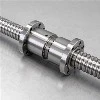
While shaft diameter is a fundamental dimension, it is only one piece of the puzzle. Two ball screws with the exact same diameter can feature completely different leads, nut types, accuracy grades, preload methods, and shaft end configurations. Consequently, their load capacities, maximum permissible speeds, and positioning accuracies will vary drastically.
To prevent costly mismatches, engineering teams should follow a structured, five-step selection workflow based on actual operating conditions.
A 5-Step Guide to Correct Ball Screw Selection
Step 1: Define the Motion and Operating Conditions
Before looking at any product catalog, define the physical environment and performance requirements:
Mass & Orientation: Determine the total mass of the worktable and workpiece, and whether the orientation is horizontal or vertical. (Note: Vertical axes require careful evaluation of gravity loads and brake-failure prevention mechanisms).
Stroke & Dynamics: Establish the effective stroke, maximum linear velocity, acceleration/deceleration rates, duty cycle (cycles per day), and target design life.
External Forces: Account for guide rail friction, external axial forces, and potential shock loads.
Step 2: Determine the Lead and Rotational Speed
The lead-the linear distance the nut travels in one full revolution of the screw-directly dictates the system's mechanical advantage and speed dynamics.
Large Leads: Ideal for high linear velocities, though they require more motor torque for the same thrust and reduce linear resolution.
Small Leads: Best for low-speed, high-thrust, or micro-positioning applications.
Formula: Estimate the required rotational speed using:
Rotational Speed (RPM)= Linear Velocity/Lead
Once calculated, verify this against the critical speed limit of the screw based on its diameter, unsupported length, and support configuration to prevent destructive resonant vibrations.
Step 3: Verify Axial Load, Lifetime, and Buckling Stability
A ball screw must simultaneously satisfy demands for axial load capacity, fatigue life, and structural rigidity.
Calculations: For high-frequency, variable-load applications, calculate the equivalent mean axial load over a complete work cycle rather than just relying on peak loads.
Buckling Resistance: For vertical setups or applications under compressive loads, perform a buckling analysis to prevent the shaft from bending under pressure.
Real-world Factors: Account for shock loads, mounting misalignments, lubrication frequency, and environmental contamination, all of which directly impact L10 bearing life.
Step 4: Balance Accuracy Grades and Preload
Not every application requires sub-micron precision. Matching the right specification to the application optimizes both performance and cost:
Standard Transport & Lifting: General automation, packaging, and material handling typically utilize rolled ball screws with standard accuracy and axial play.
High-Precision Systems: CNC machine tools, semiconductor manufacturing, and metrology equipment require ground ball screws with strict lead accuracy, zero backlash, and thermal expansion management.
Preloading: While preloading eliminates axial play and boosts rigidity, it also increases driving torque and heat generation. Preload levels must be carefully calibrated to avoid premature wear.
Step 5: Select the Nut Style and Support Configurations
The physical integration of the ball screw defines its ultimate reliability:
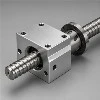
Nut Geometry: Choose flange, cylindrical, or thread-mount nuts based on spatial constraints and mounting surfaces.
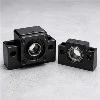
Support Configurations: Common mounting methods include Fixed-Supported, Fixed-Fixed, and Fixed-Free. Fixed ends handle axial loads, while supported ends allow for thermal expansion. High-speed, long-stroke systems require robust dual-fixed support to maximize rigidity and elevate the critical speed threshold.
The Essential Checklist for Inquiries and RFQs
To expedite the RFQ process and guarantee an optimal engineering fit, global buyers should provide manufacturers with the following technical data:
| Category | Required Specifications |
| Dimensions | Shaft diameter, lead, effective stroke, and overall length (OAL). |
| Dynamics | Mounting orientation (horizontal/vertical), maximum velocity, and acceleration. |
| Loads | Working axial load, peak load, and any shock/external forces. |
| Precision | Target accuracy grade (e.g., C3, C5, C7) and backlash/preload requirements. |
| Mechanical | Preferred nut style, end-machining drawings, and support bearing configuration. |
Tip: If a detailed engineering drawing is not yet available, providing high-resolution photos of the existing ball screw, its nameplate, and key envelope dimensions can significantly accelerate the design phase.
About Tianjin Ounaida
Ball screw selection is a delicate balance of load, speed, accuracy, lifetime, rigidity, and budget. As a trusted manufacturer of precision transmission components, Tianjin Ounaida provides end-to-end support-from initial application analysis and custom shaft-end machining to final assembly verification. By analyzing your complete operating conditions upfront, we eliminate design mismatches and deliver plug-and-play linear motion solutions directly to your production line.
For technical consultations or to request a quote, please contact our engineering sales team.
Media Contact:
Tianjin Ounaida Transmissions Technology Co., Ltd.
Precision Linear Motion Solutions
[www.tjond.com]
[sales@tjond.com]