


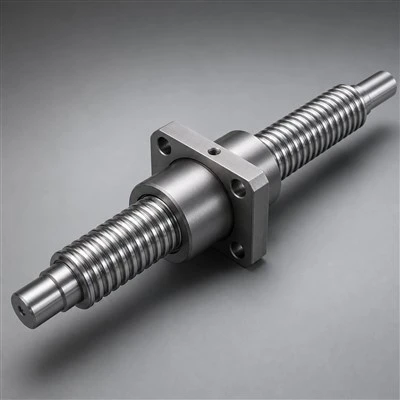
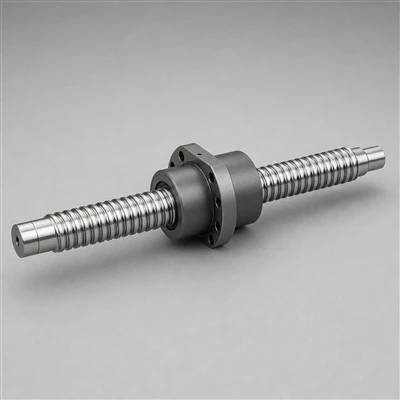
SFI3210 Circulation Ball Screw
Tianjin OuNaiDa Transmissions Technology Co., Ltd. is one of the leading manufacturers and suppliers of sfi3210 circulation ball screw in China. If you're going to buy high quality sfi3210 circulation ball screw, welcome to get more information from our factory. Also, custom service is available.
SFI3210-4 Internal-Circulation Ball Screw: 32 mm Shaft, 10 mm Lead, 4,805 kgf Dynamic Load
The question that usually leads here: "We need the axis to move faster but the machine is already built. How much can we change without redesigning the mounts?"
If the existing screw is a 32 mm shaft with a 5 mm lead, the answer is often the SFI3210-4. Same shaft diameter, double the lead, and - because it is an internal-circulation design - a nut that stays compact instead of growing a return tube that needs clearance.
What people do not expect is that the load rating goes up at the same time. Usually a speed change costs you something.
Why the Load Goes Up With the Lead
Larger lead means a larger ball. The 5 mm lead version of this shaft runs 3.175 mm balls. The 10 mm lead version runs 6.35 mm balls - exactly double the diameter. Bigger balls, bigger contact area, higher rating.
| Model | Shaft d (mm) | Lead (mm) | Ball Da (mm) | Ca (kgf) | Coa (kgf) | Rigidity (kgf/µm) |
|---|---|---|---|---|---|---|
| SFI3204-4 | 32 | 4 | 2.381 | 1,296 | 4,838 | 49 |
| SFI3205-4 | 32 | 5 | 3.175 | 1,922 | 6,343 | 52 |
| SFI3210-4 | 32 | 10 | 6.35 | 4,805 | 12,208 | 62 |
Against the 5 mm lead version on the same shaft, dynamic capacity rises by 150% and static by 92%. Rigidity goes from 52 to 62 kgf/µm.
The trade is real, though, and it is not in the load numbers. Ten millimetres of travel per turn of the shaft means one motor step moves the table twice as far as it would on a 5 mm lead. Your positioning resolution halves. Whether that matters depends on your encoder and what tolerance you are holding - but it is the thing to check before ordering, not after.
Full Dimensions
| Parameter | SFI3210-4 |
|---|---|
| Shaft diameter d (mm) | 32 |
| Lead l (mm) | 10 |
| Ball diameter Da (mm) | 6.35 |
| Nut outer diameter D (mm) | 54 |
| Flange diameter A (mm) | 88 |
| Flange thickness B (mm) | 15 |
| Nut length L (mm) | 90 |
| Flange width W (mm) | 70 |
| Flange height H (mm) | 62 |
| X (mm) | 9 |
| Y (mm) | 14 |
| Z (mm) | 8.5 |
| Grease nipple Q | M8 |
| Circuits n | 1×4 |
| Basic dynamic load Ca (kgf) | 4,805 |
| Basic static load Coa (kgf) | 12,208 |
| Rigidity (kgf/µm) | 62 |
| Nut weight (kg) | 1.14 |
Source: OND ball screw and linear guideway catalogue, SFI series table, p.14. Load values are quoted in the units printed in that table - kgf for both Ca and Coa.
A note on that: our guideway tables print load ratings in kN and our SFI screw table prints them in kgf. They are different units in different tables. Do not convert one and compare it against the other as though both came from the same column.
Picking Between the Obvious Alternatives
Against SFI2510-4 (25 mm shaft, same 10 mm lead): Ca 4,805 against 2,954 - a 63% increase. If you have the space for a 32 mm shaft and the stroke is long enough that shaft rigidity matters, the larger diameter is the better buy.
Against SFI4010-4 (40 mm shaft, same 10 mm lead, same 6.35 mm ball): Ca 5,399 against 4,805, so only 12% more capacity for a nut that goes from 54 to 62 mm OD and 1.14 to 1.548 kg. If 4,805 kgf covers your load, the 32 mm is the more sensible package.
Against an external-circulation screw of the same size: the return tube sits outside the nut body and needs clearance around it. Where the nut has to pass through a bore or sit close to a casting wall, an internal-circulation nut is the one that fits.
The Part That Catches People Out
Internal-circulation nuts have an assembly requirement that external ones do not. PMI states it plainly in their internal ball series documentation: "It is strictly required that there is at least one end of screw shaft with complete threads. Also the rest area next to this complete thread must be with smaller diameter than the nominal diameter of the screw shaft."
In practice: the nut has to slide on from an end, and nothing on that end can be fatter than the 32 mm nominal. If your drawing has a 35 mm shoulder machined near the end for a bearing seat, the nut cannot get past it. We have had to re-machine shafts over this.
Send us the shaft end drawing with the order and we will check it before anything is cut.
Other Things Worth Knowing Before You Install
It needs a guide. A ball screw is not a linear bearing. THK's handling guidance is direct about it: "Use the Ball Screw by providing a LM Guide, Ball Spline or other guide element. Otherwise, the Ball Screw may be damaged." Pair it with a profiled rail sized for the moment load, not just the axial one.
Mounting rigidity decides the life. THK again: "Insufficient rigidity or accuracy of mounting members causes the bearing load to concentrate on one point and the bearing performance will drop significantly." And on alignment: "If an offset or skewing occurs with the Ball Screw shaft support and the Ball Screw nut, it may substantially shorten the service life."
That is not a small effect. A screw that is correctly specified and badly mounted will not reach its rated life, and the failure will look like a product defect.
Temperature ceiling. THK specifies not using ball screws at 80 °C or above, except for heat-resistant models, because the resin and rubber components deform or get damaged. Enclosed housings with no airflow get hotter than people assume.
Lubrication is not optional. THK's reference interval for ball screws is approximately every 100 km of travel distance, which they put at three to six months, with the final interval set on the actual machine. Our note on nut housings and coupling selection covers the rest of the drive chain.
Accuracy Grades
If your enquiry specifies a grade, ISO 3408-3:2006 is the standard that defines what it means. It "specifies the technical acceptance conditions for ball screws and, in particular, the respective permissible deviations for the acceptance tests." It is Edition 2, published June 2006, and ISO last reviewed and confirmed it in 2026, so the version remains current.
Tell us the grade you need and the stroke it applies over. A tolerance quoted without a stroke length is not a specification.
Ordering
We need: shaft length, both end machining drawings, accuracy grade, whether you want end support units supplied with it, and the environment it runs in. If there are chips or coolant about, say so - THK recommends bellows or covers where "cutting chips, coolant, corrosive solvents, water, etc., may enter the product," and it is cheaper to design that in than to retrofit it.
Related: SFU2510-3/4 for the external-circulation equivalent, lead against speed and thrust if you are still choosing a lead, and end support configuration for the bearing arrangement.
Tianjin OuNaiDa Transmissions Technology Co., Ltd. manufactures ball screws, support units, linear guideways, gears, racks, sprockets and couplings. Established 2008, CE and ISO 9001:2015.
Hot Tags: sfi3210 circulation ball screw, China sfi3210 circulation ball screw manufacturers, suppliers, factory
Previous
No InformationYou Might Also Like


Send Inquiry