Ball Return Systems: Why Two Screws With the Same Part Number Behave Differently
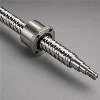
Two suppliers quote you an SFU1605. Same diameter, same lead, same 3.175 mm balls, comparable load ratings. One runs quietly and smoothly; the other is noticeably noisier at speed and has a small cyclic variation in running torque.
The difference is usually inside the nut, in the part of the design that datasheets rarely describe: the ball return system.
The balls cannot simply travel along the thread forever. At the end of each circuit they must be lifted out of the raceway, carried back, and reinserted. How that transition is engineered determines noise, speed capability, and how smoothly the screw runs.
The Three Approaches
Internal single-turn return. The balls are picked up by a formed insert within the nut body and passed back over a single thread turn. Compact - the nut can be short, because the return path is not external. Each circuit is short, which limits how many balls share the load per circuit.
External tube return. A formed steel tube outside the nut body collects balls at one end of the circuit and delivers them back to the other. Allows longer circuits with more load-carrying balls, and the return geometry can be made generous. The tube protrudes, so the nut envelope is larger and the tube itself needs protecting.
End cap return. Caps at each end of the nut pick up balls and route them through a bore drilled axially through the nut wall. Good for high lead screws where the helix angle makes a single-turn pickup difficult. The end caps are a moulded or machined component and their fit matters.
The nut dimension tables tell you which approach a series uses, indirectly. Look at the circuit notation: 1×3 means one turn by three circuits, 1×4 means one turn by four. A series listing 1×2 or 1×3 on coarse leads and 1×4 on fine leads is telling you something about how the designer balanced circuit length against nut length.
Why It Shows Up as Noise
Every ball entering or leaving the raceway makes a small transition. At the pickup point it changes direction and briefly stops carrying load; at reinsertion it accelerates back into the raceway.
If that transition is smooth and the geometry is generous, the ball flows. If the pickup is abrupt, or the return channel is slightly misaligned, the ball is struck rather than guided - and the sound of thousands of those events per second is what you hear as ball screw noise.
Noise is therefore a reasonable proxy for return system quality. A screw that is loud at moderate speed, with no misalignment and correct lubrication, is usually telling you about its internals.
Two caveats before diagnosing noise this way. Check alignment and preload first - a misaligned support configuration produces noise that has nothing to do with the return system. And check lubrication, because a dry or contaminated nut is noisy regardless of how well the returns are designed.
Speed Capability
The return system is a real constraint on the nut's speed rating, and it is why the DN value limit comes from the nut rather than from the screw shaft.
At high rotational speed, the balls are moving fast through the return path. Centrifugal effects push them outward, the transition forces increase, and at some point the balls no longer recirculate cleanly. Published DN limits and maximum speed ratings for a given nut reflect this.
This is the reason a coarse-lead nut does not automatically carry a higher DN rating than a fine-lead nut of the same diameter, and why high-speed series are designed differently rather than just being standard nuts rated optimistically. If your application runs near the speed limit, the nut series matters more than the shaft.
Balls Per Circuit and Load Sharing
Load capacity in a ball screw comes from the number of balls actually carrying load at any moment. More circuits, or longer circuits, means more load-bearing balls and a higher dynamic rating.
This is visible in the dimension tables once you know to look. Compare two nuts of the same diameter and lead where one is longer: the longer nut has more circuits, and its dynamic load rating is higher. Nut length is not arbitrary packaging - it is load capacity.
Which means: if you are choosing between a short nut and a long nut of the same nominal specification, you are choosing between envelope size and load capacity. Do not treat the short one as simply more compact for free.
What This Means When Buying
You cannot usually inspect the return system before purchase, so use indirect indicators.
Ask about circuit configuration. A supplier who can tell you the circuit notation and explain the return type understands their own product. One who cannot may be reselling.
Compare load ratings at equal dimensions. If two nuts have the same diameter, lead, and length but noticeably different dynamic ratings, the difference is in the internals. That is worth a question.
Listen to a sample under load. Not on a bench with no load and no alignment - in a representative mount at representative speed. Noise and torque consistency tell you more than the datasheet.
Check torque consistency, not just magnitude. A nut with a good return system has running torque that is steady through rotation. Cyclic variation once per revolution suggests either a return transition issue or a raceway inconsistency.
Match the series to the duty. High-speed applications should use a series designed for it. Dusty environments should use a sealed series. The return system inside those series is designed around that duty.
When Something Goes Wrong
Return system problems have a characteristic signature. Noise that appears suddenly rather than gradually, running torque that spikes at one point per revolution, or metallic debris in the grease with no visible raceway damage - these point inside the nut rather than to alignment or lubrication.
A nut with a damaged return path is generally not economically repairable in the field. The practical response is replacement, and then working out what got in there or what overloaded it.
If you have a nut failing this way, send us the symptoms and the operating conditions. The failure pattern usually indicates whether the cause was contamination, overspeed, or a specification mismatch - which determines whether the replacement should be the same series or a different one.
Specification Support
When you send us an application rather than a part number, the nut series is one of the things we select. Speed, load, duty cycle, and environment each push toward a different internal design, and the right answer is often not the cheapest nut with the right diameter and lead.
Tianjin OuNaiDa Transmissions Technology Co., Ltd. manufactures ball screws, support units, nut housings, couplings, linear guideways, gears, racks and sprockets. Established 2008, with 20 years of manufacturing and 15 years of export experience serving over 300 overseas distributors, to CE and ISO 9001:2015 standards.
Precision Motion Components | Empowering Global Intelligent Manufacturing