In order to increase the rigidity of the rack during the manufacturing process, there are many treatment methods, mainly through heat treatment. Heat treatment is the process of heating or cooling metal materials in order to obtain the required metal structure properties. With different cooling methods, different structures are obtained. Heat treatment is roughly divided into normalizing, annealing, quenching, tempering, surface hardening, etc.
(1) normalizing
Normalizing is a heat treatment method for refining steel grains and uniform internal structure. The purpose of normalizing treatment is to eliminate the internal stress generated during mechanical processing and the fibrous structure generated during plastic processing such as calendering.
(2) Annealing
Annealing is a heat treatment method for softening steel, adjusting crystal structure, removing internal stress, and improving cold rolling and machinability. According to the purpose of use, annealing is subdivided into complete annealing, spheroidizing annealing, stress relief annealing, intermediate annealing, etc.
(3) Quenching
Quenching is the process of rapid cooling of steel after high temperature heating. Improve the hardness and strength of steel. According to the cooling conditions, it can be divided into water quenching, oil quenching, vacuum quenching, etc. The quenched material must be tempered.
(4) Tempering
Tempering is a heat treatment in which steel is reheated to a certain temperature after being hardened, and then cooled at an appropriate rate. The main purpose of tempering treatment is to adjust material hardness, improve toughness and eliminate internal stress. According to the tempering temperature, tempering can be divided into low temperature tempering and high temperature tempering. The higher the tempering temperature, the lower the hardness of the material and the stronger the toughness. Quenching and tempering processing adopts high temperature tempering. The tempering treatment after surface hardening such as high frequency quenching, carburizing and quenching is low temperature tempering.
(5) Conditioning
Quenching and tempering is a heat treatment that combines quenching and tempering (high temperature) treatment to adjust the hardness/strength/toughness of steel. The hardness of the material after quenching and tempering treatment is within the range of general mechanical processing.
General quenching and tempering hardness is as follows.
S45C (carbon steel for mechanical structure) 200~270HB
SCM440 (alloy steel for mechanical structure) 230~270HB
(6) Carburizing and quenching
Carburizing and quenching is a heat treatment in which carbon is infiltrated into the surface of low carbon steel and then quenched. The surface layer infiltrated with carbon gives high hardness. After quenching, it is tempered at low temperature to adjust the hardness. After the material is carburized and quenched, the hardness of the core will also increase to a certain extent, but it will not reach the level of the surface. If an anti-carburizing agent is applied to a part of the material, it can prevent the infiltration of carbon and achieve the purpose of preventing the hardness of this part from becoming high. Surface hardness and hardened layer depth are roughly as follows
Quenching hardness 55~63HRC (reference)
Effective hardened layer depth 0.3~1.2mm (reference)
The gear is deformed after carburizing and quenching, and the precision of the gear is reduced. In order to improve the precision of the gear, the gear must be ground.
(7) High frequency quenching
High-frequency quenching is a quenching heat treatment that hardens the surface of a steel material with a carbon content of more than 0.30% by induction heating. After high-frequency quenching, the tooth surface and tooth top of the gear can get high hardness. However, there is a possibility that hardening may not be obtained at the root portion of the tooth. Due to the deformation caused by high-frequency quenching, the accuracy of gears generally decreases.
(8) flame quenching
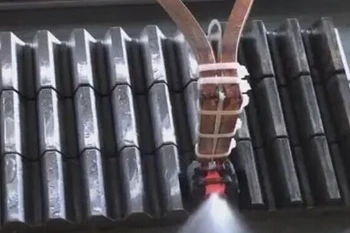
The heat source is surface heat treatment with an open flame. It is mainly used when any surface or a certain part of steel needs to be quenched.
(9) Nitriding
A heat treatment method that diffuses nitrogen into the surface of the steel to harden the surface of the steel. Steel materials containing aluminum, chromium, and molybdenum are easy to increase hardness through nitriding treatment. A representative nitrided steel is SACM645 (aluminum molybdenum steel).
(10) Whole piece quenching
The whole piece is heat-treated by heating, rapid cooling and quenching. The surface core of the material reaches the same hardness.